It’s interesting that prolific playwright Guelan Varela Luarca chose “Ang Linangan” as the title of his Filipino translation of Davis Alianiello’s “The Farm.” He could have opted for something more straightforward like “sakahan” or “bukid,” but “linangan” carries a certain weight. It suggests a cultivation — etymologically linked to “cult” — a connection that sits at the heart of the play.
There is even an accidental poetry to it. Read too quickly, “linangan” can easily slip into “linlangan” or deception. It’s a subtle but fitting echo of the play’s uneasy terrain.
But don’t let the formal title fool you. Rather than opting for a more literary Filipino, Luarca leans into a contemporary, conversational Tagalog, closer to how people actually speak today. The result is a text that feels immediate and accessible, grounding what might otherwise seem like a distant, foreign premise — a choice that has sparked a debate within theater circles.
Because while “Ang Linangan” is set against the backdrop of a fictional cult in Italy, its emotional core feels unmistakably familiar.
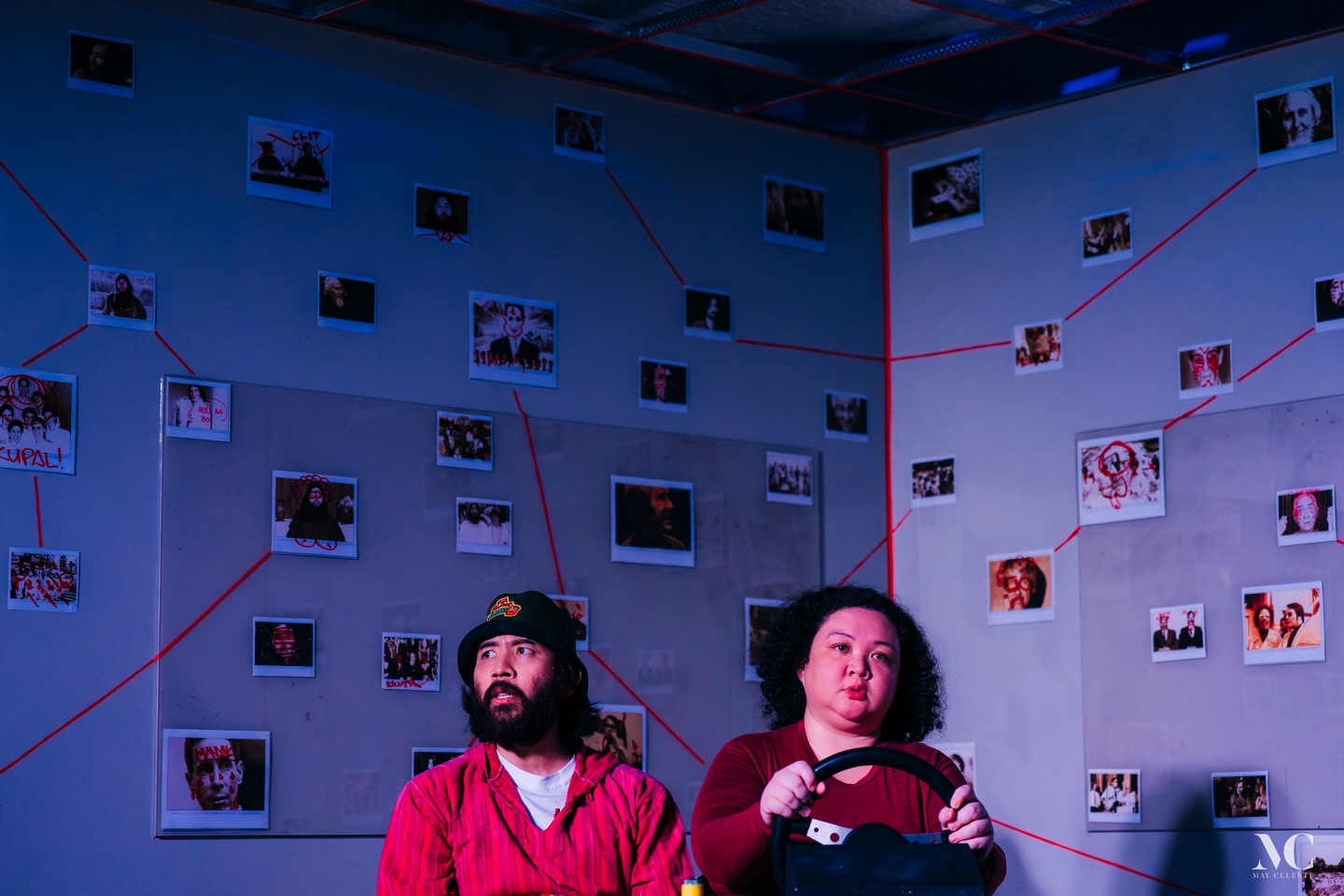
Look closely at the set and you’ll see a wall of interconnected “cult” figures, including some local personalities. It looks like something straight out of a detective’s office, hinting that these organizations aren’t just a foreign concept — they’re right here among us.

The play unfolds mostly inside a car at 4 a.m., in the dead of a New England winter. Sasha picks up her brother Tyler, who has just returned after two years in the cult. What follows is less a journey than a confrontation — of absence, resentment, and the fragile threads that still bind them.
It is, at its heart, a sibling story. And it works largely because of the actors.
Brian Sy and J-mee Katanyag inhabit their roles with an ease that makes their relationship instantly believable. Their chemistry is unforced, lived-in, with a fondess that only comes from shared history.
Katanyag, now better known as a director and playwright, proves to be a formidable presence onstage. There is precision in her emotional shifts, and a natural command of both humor and tension. Much of the play’s weight rests on Sasha, and Katanyag carries it with remarkable control. If anything, “Ang Linangan” serves as a reminder of just how compelling she is as an actress, having seen her act before in Virgin Labfest.
The dynamic between the two often feels like overhearing a private argument — raw, unfiltered, and occasionally uncomfortable. Sasha’s frustration is sharp, unrelenting; Tyler, on the other hand, carries a certain gullibility — there’s a cuter word for it, I know — that makes his susceptibility to the cult plausible.
Here, Luarca’s translation does its most effective work. The circumstances may seem foreign, but the rhythms of the relationship feel distinctly Filipino. Their exchanges, their emotional shorthand — it all lands with a resonance that bridges the cultural gap.

If there is a moment that gently reminds us of the play’s translated nature, it comes in small, practical details — deliberate choices where linguistic consistency takes precedence over strict realism. When Sasha calls AAA after their car stalls, she continues speaking in Filipino rather than switching to English, as a Fil-American character might naturally do in that situation. It’s a minor but noticeable choice, one that underscores the production’s commitment to a cohesive linguistic world.
Structurally, the play makes an interesting choice. The first act, confined largely within the car, is taut and compelling — almost self-contained. The second act, considerably shorter, expands the narrative and offers additional insight into the characters, particularly Sasha. Yet it feels more like an extension than a necessity, arriving after what already seems like a natural emotional endpoint. One is left wondering if “Ang Linangan” might have been even more potent as a one-act piece, preserving the intensity of its central encounter.
Still, the production succeeds where it matters most.
What’s great about all this is how it starts a real conversation about language. It shows that the words we choose — whether they’re formal or the slang we use every day — completely shape how we understand a story. “Ang Linangan” doesn’t feel like a translated play; it feels like it was always meant to be told in our own voice.
Above all, it is a worthy addition to Scene Change’s growing body of work.
“Ang Linangan” runs until March 29 at the Joselito and Olivia Campos Interactive Room, in Areté, Ateneo de Manila University.
This review was originally published on ABS-CBN.com.


Leave a Reply