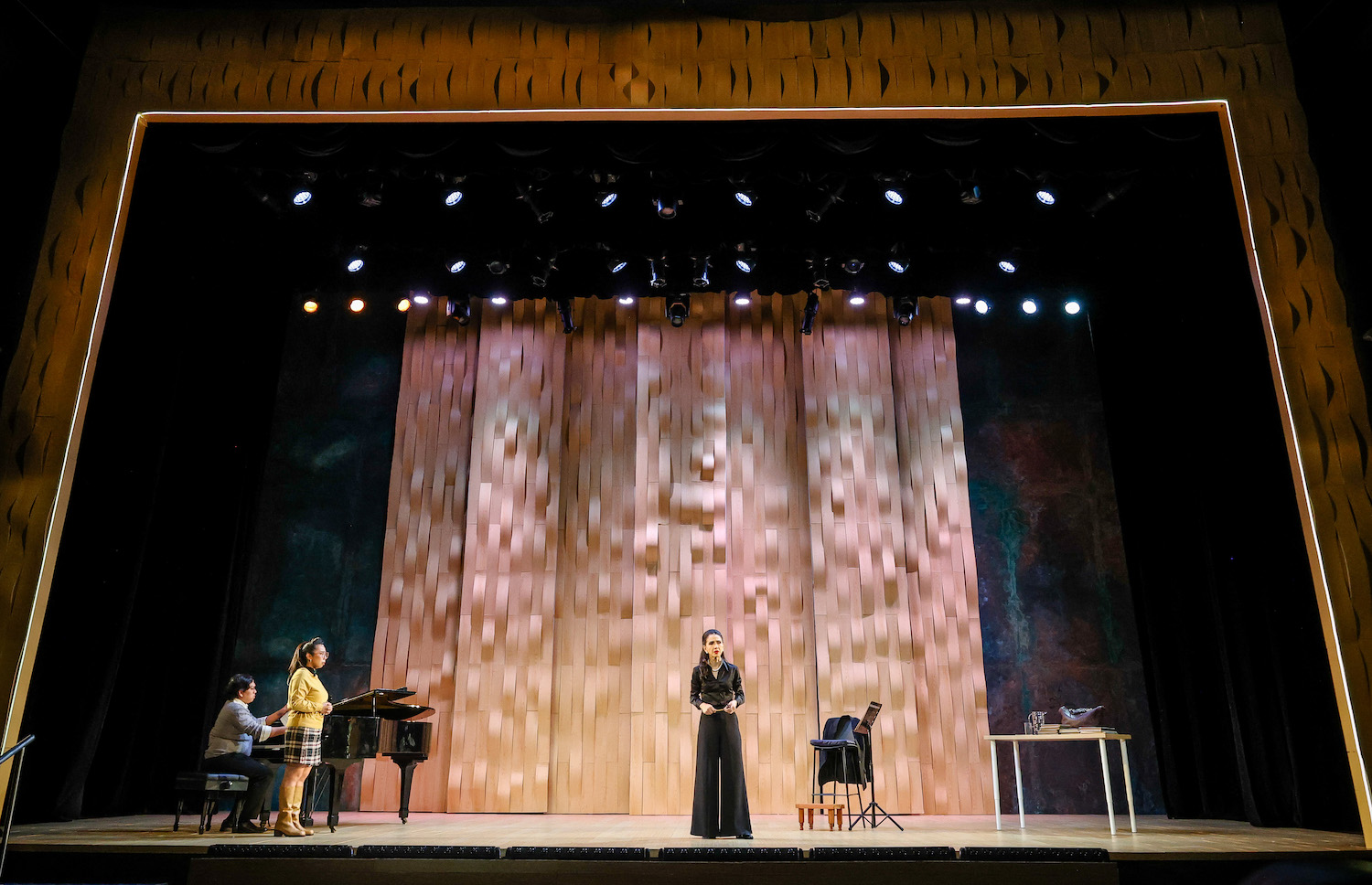
How fortunate that the Philippine Opera Company decided to stage “Master Class” once again just a little over a year after the release of “Maria,” Pablo Larraín’s biopic on legendary opera singer Maria Callas.
The two works complement each other remarkably well. Watching both offers a fuller understanding not only of who Callas was, but why she continues to captivate audiences decades after her death.
The film, led by an Oscar-snubbed performance from Angelina Jolie, focused largely on Callas as an icon — glamorous, tragic and isolated during the final week of her life in Paris in 1977. In the film, Callas speaks poignantly about wanting to reclaim her voice for herself after years of other people controlling it: her mother forcing her to sing, and later, Aristotle Onassis pulling her away from her art.
But as critic Richard Brody observed in his review for The New Yorker, the film emphasized the mythology surrounding Callas more than the labor and discipline behind her artistry.
This is precisely where “Master Class” fills the gap. Written by Terrence McNally, the play shifts the focus from Callas the celebrity to Callas the artist and mentor. Inspired by the real master classes Callas conducted at the Juilliard School in 1971, six years before her death, the play uses her interactions with three students to reveal the passion, rigor and sacrifices behind her greatness.
In his director’s notes, Jaime del Mundo mentions that his interest lies less in the gossip and drama surrounding Callas and more in her role as a teacher — a perspective that shapes the production beautifully.

At its core, “Master Class” is practically a one-woman show.
While several students pass through Callas’ lessons, the stage belongs almost entirely to Menchu Lauchengco-Yulo, whose commanding performance anchors the production from beginning to end. Accompanied throughout by the pianist, Callas recounts stories from her career, critiques her students and occasionally drifts into deeply personal memories.
Through these interactions, we see a woman who is exacting, intelligent, pedantic, but also funny, passionate and ultimately generous. She demands excellence because she understands the immense discipline required to achieve greatness.
In many ways, the play resembles an extended TED Talk on art and creative pursuit — a meditation on what it truly costs to devote one’s life to mastery.
The Philippine Opera Company made an inspired decision in assembling this team. Del Mundo, an avowed opera enthusiast, approaches the material not simply with academic admiration but with genuine affection for the art form.

Then there is Lauchengco-Yulo, already a towering figure in Philippine musical theater as an actress, singer, and director. “Master Class” feels almost tailor-made for an actress of her caliber.
The role of Callas has historically attracted formidable performers. Previous local productions featured theater legends such as Baby Barredo and the late Cherie Gil, both artists known for their commanding stage presence. Lauchengco-Yulo more than earns her place alongside them.
The production cleverly stages the play as an actual public session, with Callas directly addressing the audience as though they are students sitting in on the class. There is no fourth wall. From the moment Lauchengco-Yulo walks onto the stage, she commands the room with confidence and authority.
What makes the performance especially impressive is that it never devolves into mere impersonation.
Yes, there are visual approximations of Callas — the tailored pantsuit, the makeup, the carefully measured European inflection — but Lauchengco-Yulo focuses more on embodying Callas’ intelligence, wit, vulnerability and intensity.
Watching her feels less like observing an actress “playing” Callas and more like attending an actual lecture as the insights the character shares throughout the show are genuinely compelling. Whether discussing technique, artistry or emotional truth in performance, Callas’ lessons extend beyond opera and become reflections on discipline, sacrifice and creative integrity itself.
Lauchengco-Yulo delivers these moments with such conviction and clarity that the production becomes thoroughly absorbing even in its quieter stretches.
If there is one minor weakness in the production, it lies with some of the actors playing the students. While vocally strong, a few scenes occasionally feel obviously acted, momentarily disrupting the illusion that we are witnessing a real master class unfold in real time.

Still, the vocal performances themselves are impressive, particularly as the students visibly improve under Callas’ instruction.
Arman Ferrer delivers one of the show’s strongest vocal showcases during his “Tosca” performance, where the audience can clearly hear how Callas’ guidance transforms the emotional and technical quality of the piece in real time.
Another standout comes from Angeli Benipayo performing Verdi’s “Macbeth,” whose powerful vocals hint at extraordinary promise.
Yet the true emotional peaks of “Master Class” arrive during Callas’ extended monologues, where the classroom setting dissolves and memory takes over.
As Callas recalls pivotal moments from her life — her La Scala debut, her relationship with Onassis — Lauchengco-Yulo becomes utterly moving. Del Mundo heightens these scenes by weaving recordings of Callas’ actual singing into the background, creating an almost haunting fusion of memory, music and performance.
In these moments, the production fully captures what made Maria Callas such a singular figure: not simply her fame or glamour, but the intensity with which she lived and pursued her art.
Taken together, “Maria” and “Master Class” form an unexpectedly moving portrait of Callas — one exploring the woman behind the legend, the other illuminating the artist behind the woman.
Whether you watch the film first and the play afterward or experience them the other way around, both deepen one’s appreciation for one of the greatest opera singers of the 20th century.
But even on its own, “Master Class” is well worth seeing — not only as a tribute to Maria Callas, but as a passionate reflection on art, discipline and the pursuit of excellence itself.

“Master Class” runs until May 30 at the Carlos P. Romulo Auditorium, RCBC Plaza, Makati.

Leave a Reply