Like many Filipinos, my first encounter with ‘Jesus Christ Superstar’ was not onstage but through the film — or more specifically, through the original soundtrack album featuring Ted Neeley as Jesus and Carl Anderson as Judas.
Looking back now, the original film is unmistakably a product of the 1970s. It is deeply hippie-coded and even unintentionally funny in the way many older films become with time. But beneath the groovy aesthetic and desert-pageant visuals was something surprisingly durable.
Andrew Lloyd Webber and Tim Rice did not create a traditional biblical musical. They created a modern retelling of the final days of Jesus Christ through the language of rock music.
That modernity is essential to why “Jesus Christ Superstar” continues to endure. Every successful version of the show understands that the material must feel contemporary to its audience. The original film reflected the counterculture aesthetics of the 1970s. Later productions leaned into futurism, arena-rock bombast, or sleek modern minimalism.
And somehow, unlike many rock musicals from the same era, the score itself has barely aged. Compared with something like “Hair,” which today feels more tied to a very specific cultural moment, “Jesus Christ Superstar” still sounds startlingly alive. From the opening guitar riff onward, the music retains an immediacy that many newer musicals still struggle to achieve.
The overture alone remains one of the most thrilling openings in musical theater. The guitars snarl. The rhythms attack. The arrangements surge forward with relentless momentum. There is almost no separation between rock concert and theater score here. Long before jukebox musicals dominated theater, this was already a full-fledged rock concert disguised as musical theater.

Over the years, I’ve watched different versions reinterpret that concept. There was the arena tour starring Ben Forster, Tim Minchin and Melanie C, which fully embraced contemporary fashion and concert aesthetics. I remember seeing another production years ago on VCD that leaned heavily into futuristic ‘Matrix’-style costuming.
Then came the televised concert version starring John Legend, which balanced biblical imagery with modern celebrity culture. Casting an actual music superstar as Jesus changed the atmosphere completely. When fans screamed for him, it no longer felt like theater pretending to depict fame. The adoration became real.
More recently, there was the concert staging featuring Cynthia Erivo and Adam Lambert, both performers whose vocal styles naturally fit the emotional extremity of the material.
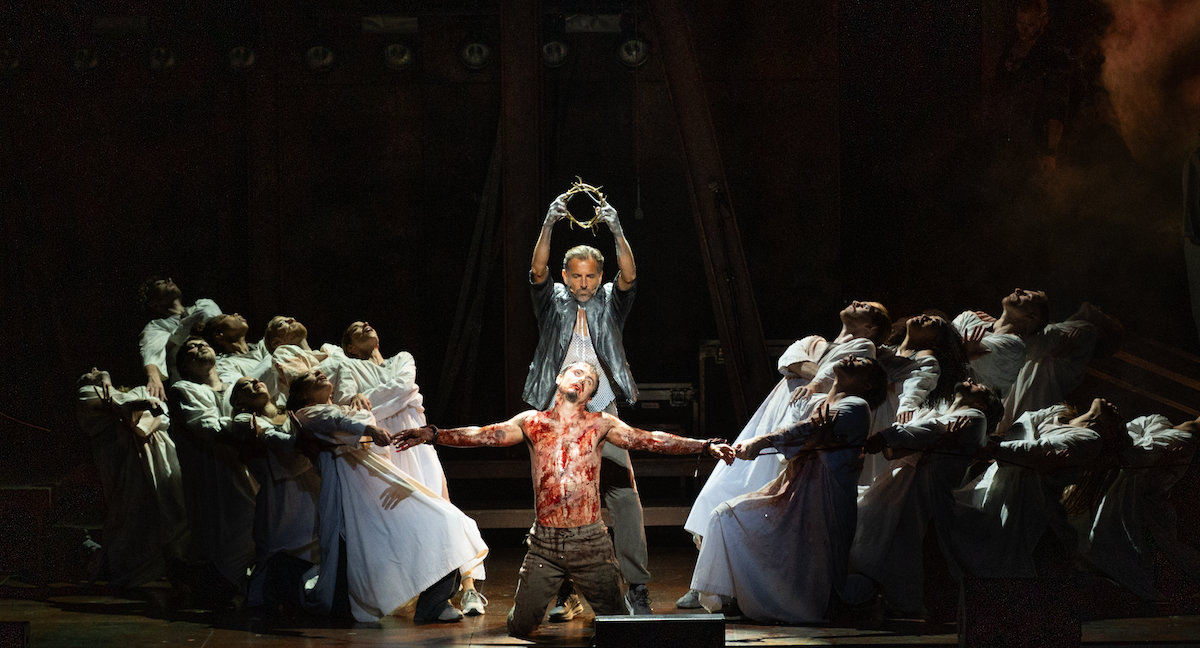
All of which brings us to this current international touring production, which originated from the acclaimed 2016 UK staging by The Regent’s Park Open Air Theatre. This version understands exactly what makes “Jesus Christ Superstar” work.
Rather than radically reinventing the musical, the production refreshes the original spirit for contemporary audiences. The ensemble enters through the audience wearing muted streetwear before effectively “putting on” the story in front of us, echoing the theatrical self-awareness of the original film.
The styling immediately caught my attention. I do not know whether it was intentional, but the oversized silhouettes, earth tones and layered neutral fabrics strongly recalled the Fear of God aesthetic with Jesus and the ensemble looking contemporary, urban and recognizable. And that choice works because the production never allows the audience to distance itself from the story as something ancient or untouchable.

The concert influence extends throughout the production. Performers use handheld microphones and mic stands instead of pretending the show exists in a purely theatrical space. Several moments feel deliberately staged like live arena performances. Even the choreography blends contemporary dance, street movement and hip-hop vocabulary rather than traditional Broadway choreography.
At times, the show feels less like a conventional musical and more like a massive live concert event that happens to tell a biblical story.
Despite all these modern flourishes, the production never feels irreverent. In a predominantly Catholic country like the Philippines, that balance matters. What was once controversial in the 1970s now plays less as provocation and more as reinterpretation — contemporary, stylish and emotionally accessible without mocking the material’s spiritual core.
Still, what ultimately elevates this production above many previous stagings is its sheer musical force. And that force depends heavily on the actor playing Jesus.
I actually saw this production twice. The first time, the role of Jesus was performed by an understudy. More than anything, that experience revealed just how dependent this staging is on the emotional and vocal authority of its lead. Watching the show again with Luke Street as Jesus completely transformed the experience.
For all the long-running arguments that “Jesus Christ Superstar” is really Judas’ show, the emotional temperature of the production still rests largely on the actor playing Jesus. Street brings not only formidable vocals, but also charisma, vulnerability and emotional authority. His performance lifts the atmosphere of the entire production. More importantly, he understands the emotional progression of the role.
And then there’s “Gethsemane.” Playing the guitar himself, Street cuts a distinctly modern rockstar figure, but it is his performance of the number that is nothing short of astonishing. The vocals themselves were extraordinary — controlled yet emotionally raw, powerful without becoming self-indulgent. But beyond the technical accomplishment was the emotional honesty of the performance. The extended applause afterward felt inevitable. It is one of those rare live-theater moments where the energy in the room visibly changes.

The role of Judas, however, remains equally essential to the success of the musical. His suicide sequence, in particular, became one of the emotional high points of the production.
Interestingly, I ended up seeing two very different interpretations of the role. Javon King, who originated from the Australian production, delivered a more youthful, emotionally combustible Judas — restless, volatile and increasingly tormented by the consequences of his choices. Meanwhile, Ricardo Afonso, who previously performed the role at the Regent’s Park Open Air Theatre, approached Judas with a more mature weariness. Visually older than the boyish Street, Afonso’s Judas carried the weight of exhaustion and disillusionment, adding another emotional layer to the character.
Both performances found devastating power in the reprise of “I Don’t Know How to Love Him,” originally sung earlier by Mary Magdalene. Hearing King and Afonso perform the reprise in the same key transformed the number into something intimate, mournful and deeply tragic.
Another standout was Ethan Hardy Benson as Pilate, who gave the Roman governor surprising complexity. Rather than portraying him as a straightforward antagonist, Benson emphasized Pilate’s internal conflict — the fear, frustration, guilt and political pressure surrounding his decisions. His performance during “39 Lashes” was especially gripping, powered by commanding vocals and palpable emotional intensity — and a chest full of glitter. By the time the scene reaches its climax, Pilate feels almost as emotionally fractured as Judas.

Of course, Manila audiences will also be especially interested in Gab Pangilinan as Mary Magdalene. Pangilinan delivers a grounded and emotionally sincere performance. Some viewers may prefer a rougher or earthier interpretation, but interestingly, her performance reminded me somewhat of Sara Bareilles’ interpretation of the role — more about emotional clarity and tenderness.
Mary Magdalene is not the showiest role in the musical, but Pangilinan succeeds in giving the production a necessary emotional softness amid all the amplified guitars, emotional chaos and political tension.
And for viewers unfamiliar with her work, the production becomes an excellent showcase for just how technically accomplished she is as both an actress and singer.
What ultimately makes this production so successful is how naturally it merges the language of rock concerts and musical theater. Pilate enters like a classic leather-jacketed rock icon, while Street as Jesus almost resembles an emo or alt-rock frontman — gentle and introspective, but carrying an undercurrent of rebellion. Not quite My Chemical Romance-level theatrical angst, but perhaps closer to the emotional sincerity of bands like Simple Plan.
The ensemble moves with the intensity of backup dancers at a live concert rather than members of a traditional Broadway chorus.
Yet beneath the contemporary styling, amplified guitars and arena-concert staging remains the same emotional core that has kept “Jesus Christ Superstar” alive for decades: human conflict, doubt, devotion, betrayal and grief expressed through some of the most thrilling music ever written for the stage.
Overall, this is easily one of the strongest international musical productions to reach Manila in recent years — a staging that understands both the theatrical and rock-and-roll DNA of “Jesus Christ Superstar.”
And if you happen to catch Luke Street as Jesus, you may witness one of the most thrilling musical theater performances currently on any Manila stage.

“Jesus Christ Superstar” runs at the Theater at Solaire until May 31.


Leave a Reply