
There’s something quietly radical about what CAST PH has been doing with its staged readings. In a theater ecosystem that often prioritizes familiarity, bankability, and the comfort of the already-known, CAST continues to carve out space for work that is difficult, uncommercial, or even strange.
Its 2026 season of staged readings, for instance, felt less like a sampler and more like a statement: this is what contemporary theater can, and should, be grappling with right now.
With this year’s theme, “RE-ORIENT: Narratives from Asian Voices,” the season’s plays interrogate how Asian identities are shaped, distorted, or silenced by language, power, history, and Western gaze.
CAST opened strongly with “English” by Sanaz Toossi, the Pulitzer Prize–winning play for Drama in 2023. Set in 2008 Iran, the play unfolds in an advanced English class where students prepare for the TOEFL exam — an ostensibly simple premise that quickly deepens into a meditation on language, power, migration, and identity. Despite its specific Middle Eastern setting, “English” proves remarkably accessible. Anyone who has ever dreamed of leaving home for better opportunities, or felt the tension between assimilation and selfhood, will recognize themselves in these characters.
Acting showcase
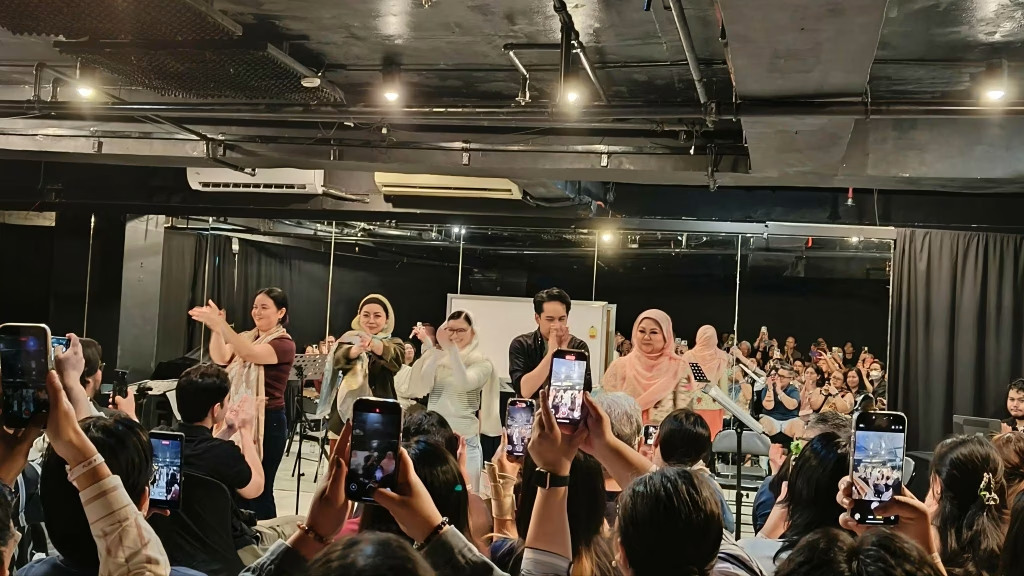
The play was also a superb acting showcase. Mikkie Bradshaw-Volante, once again, dispels any lingering notion that she is confined to musical theater. Her performance as the English teacher — recently returned to Iran after nine years abroad — was finely calibrated, full of quiet resentment and buried bitterness. There’s a sense that she has come back physically but never fully returned emotionally. Opposite her, Jordan Andrews’ Omid provided the play’s emotional pivot, his late revelation cutting to the core of what the play ultimately asks: what do we lose, and what do we betray, when we learn to speak in someone else’s tongue?
The rest completed a uniformly strong ensemble. Justine Peña disappeared into the role of Elham, fierce and competitive, deeply suspicious of English as a colonial intrusion that erodes Iranian identity. Chaye Mogg, meanwhile, was utterly winning as Goli, the one student who genuinely loves learning. Funny, sincere, and effortlessly charming, she brought a buoyancy to the play that never undercuts its seriousness. Taken together, “English” was a confident and deeply humane opener for the season — and for Philippine theater in 2026.

If “English” is about the quiet coercion of language, Rajiv Joseph’s “Guards at the Taj” confronts violence more directly — and more brutally. A two-hander running about 80 minutes, the play follows two palace guards tasked with protecting the Taj Mahal on the eve of its unveiling. At first, the play feels almost deceptively light, even absurd — an Indian-flavored cousin to “Waiting for Godot,” complete with banter, philosophical detours, and a sense that nothing much is happening.
Under Jaime del Mundo’s direction, however, the play slowly revealed its teeth. Nelsito Gomez’s Babur is youthful, impulsive, and exuberant — almost like a modern-day teenager — while Tarek El Tayech’s Humayun is rigid, obedient, and devoutly loyal to authority. Their contrasting temperaments anchor the play and give its abstractions emotional weight.
Midway through, the tone shifts dramatically when the guards receive a horrifying order: to cut off the hands of the 20,000 workers who built the Taj Mahal, ensuring that nothing more beautiful will ever be made. Whether historically accurate or not (the story remains largely a myth), the act becomes a devastating metaphor for the cost of beauty when it is enforced by power. The play plunges into questions of obedience, guilt, loyalty, rebellion, and moral responsibility — big ideas that Joseph refuses to soften.
What lingers most, though, is not the darkness but the play’s unexpected ending. El Tayech delivered it with a quiet grace that surprises and disarms, reframing the entire experience as a meditation on beauty itself — on the possibility that true beauty exists beyond human cruelty, beyond empire, beyond ambition. It’s a difficult play, one that takes time to settle into, but it ultimately rewards patience. And once again, CAST earned gratitude simply for bringing something like this to the table.
Work in progress
The season’s third offering, “Corridors” by Guelan Varela-Luarca, marked a sharp turn inward — geographically, culturally, and psychologically. Officially a work in progress (despite already winning a Palanca and existing in book form), “Corridors” feels like a convergence of Luarca’s many artistic impulses. On the surface, it resembles a family drama set inside a house, echoing “Kisapmata” or even “Quomodo Desolata Es?”. Look closer, though, and it reveals itself as something far more unsettling: a Filipino dystopia disguised as domestic realism.
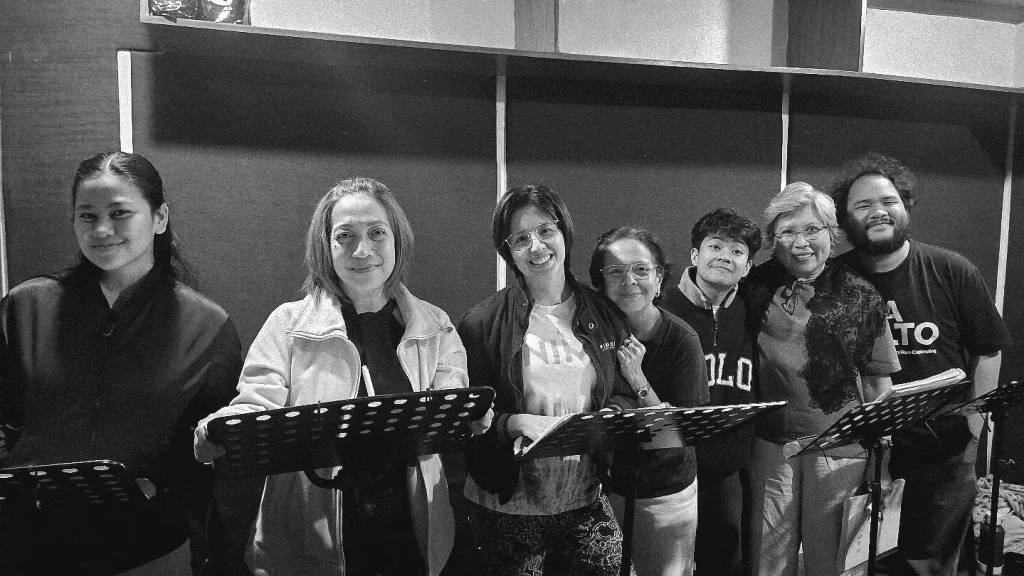
Luarca himself calls the play a Filipino allegory, and it’s hard not to read it politically, even as it remains fiercely intimate. There are familiar elements — two sisters, an old house, an artist parent, a painting — but from there, the play veers into modern Gothic horror. Not the jump-scare kind, but the slow, creeping dread that seeps in and refuses to leave. At one point, it almost feels as though the play might tip into supernatural territory — and when it doesn’t, what replaces that expectation is far more disturbing.
The world of “Corridors” is explicitly matriarchal, a reflection of what Luarca identifies as the Philippines’ matriarchal social structure. Yet the play resists easy allegory. This is not a thinly veiled portrait of any one political clan. Instead, it feels like a broader indictment of elite Filipino culture: control, cruelty, entitlement, impunity. There is a character raised abroad, seemingly unburdened by these inherited sins, who attempts to disrupt the cycle — and fails. That failure feels deliberate. The play suggests that opting out is not enough; that dismantling these systems would require courage and sacrifice on a scale we may not be capable of.
Luarca’s direction of the reading itself was also inspired. By incorporating a narrator and allowing characters to read stage directions aloud, he transformed the staged reading into something actively theatrical, drawing the audience deeper into the play’s claustrophobic world.
The piece was further elevated by the performances, particularly Roselyn Perez, formidable as the matriarch, anchoring the play’s quiet horror with terrifying authority.
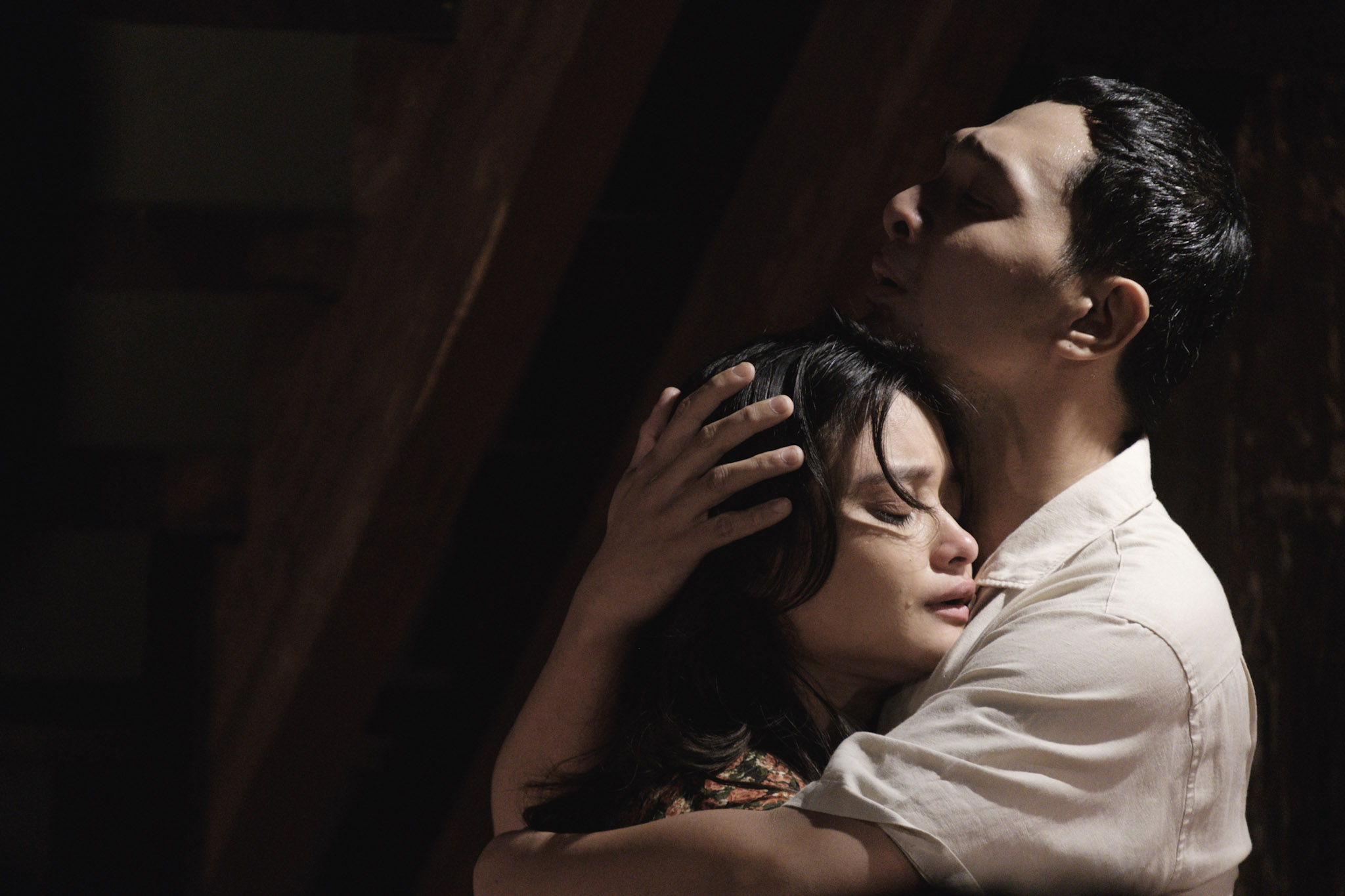
“Corridors” may be difficult to imagine as a conventional stage production, but as an art film — as it heads to Cinemalaya — it makes perfect sense. This is Luarca at his darkest, and still unmistakably brilliant.
Surprise bonus
CAST closed the season with a pairing that couldn’t be more provocative: Caryl Churchill’s “Seven Jewish Children” and Kimber Lee’s “Untitled F*ck Miss Saigon Play.” Before the final reading, director Nelsito Gomez surprised the audience with Churchill’s 10-minute piece, performed by an all-star cast of Jaime del Mundo, Topper Fabregas, and Menchu Lauchengco-Yulo. He explained that a season focused on Asian voices could not, at this moment, ignore the Israel–Palestine conflict.

Controversial since its London premiere, “Seven Jewish Children” compresses seven key moments in Jewish history — from the Holocaust to the present — into a spare, relentless exchange built around the commands “tell her” and “don’t tell her.” Each section is framed by stark death tolls on both sides. The culminating monologue, articulating a hardline Zionist position, remains deeply divisive. But it is impossible to deny the rigor of Churchill’s writing or the emotional force of this performance. For 10 minutes, the room seemed to stop breathing. Had CAST ended the show there, it would have already justified the price of admission.
By contrast, Lee’s play is messy, sprawling, and deliberately unruly. It takes aim at “Miss Saigon” — and its lineage stretching back to “Madame Butterfly” — critiquing the racial stereotypes that have long shaped Asian representation on Western stages. The central conceit, with Kim trapped in a looping theatrical death, is initially hilarious but eventually overstays its welcome. The play’s later turn toward contemporary breakdown and extended monologues reinforce points already made, contributing to a sense of excess.
Still, under Caisa Borromeo’s direction, the material ultimately finds its justification through performance. Jillian Ita-as was terrific as Kim, and one can easily imagine this becoming a career-defining role in a full production. Kakki Teodoro was in peak form — sharp, fearless, and gleefully irreverent — while Alfredo Reyes, George Schulze, Miren Alvarez-Fabregas, and Yanah Laurel provided solid support. Even as the weakest of the four offerings, the play ended the season on an energetic, laughter-filled note.
Taken together, CAST PH’s 2026 staged readings formed a season defined by risk and urgency. These are plays that ask uncomfortable questions, challenge inherited narratives, and resist easy catharsis. They reminded us why these staged readings matter — not as lesser versions of “real” productions, but as vital entry points to ideas we might otherwise never encounter.
Here’s hoping CAST returns with a seventh chapter, and that more Southeast Asian voices join the conversation next time.
This article was originally published on ABS-CBN.com.

Leave a Reply