Author’s note: This is an updated version of an essay I wrote for Maxim magazine back in 2004, or 20 years after the original ‘Bagets’ movie.

It’s hard to think of the 1980s as an innocent time. After all, it was a decade intoxicated by excess, its worldview neatly summed up by Gordon Gekko’s “Greed is good,” and soundtracked by unabashed consumerist anthems like Madonna’s “Material Girl.”
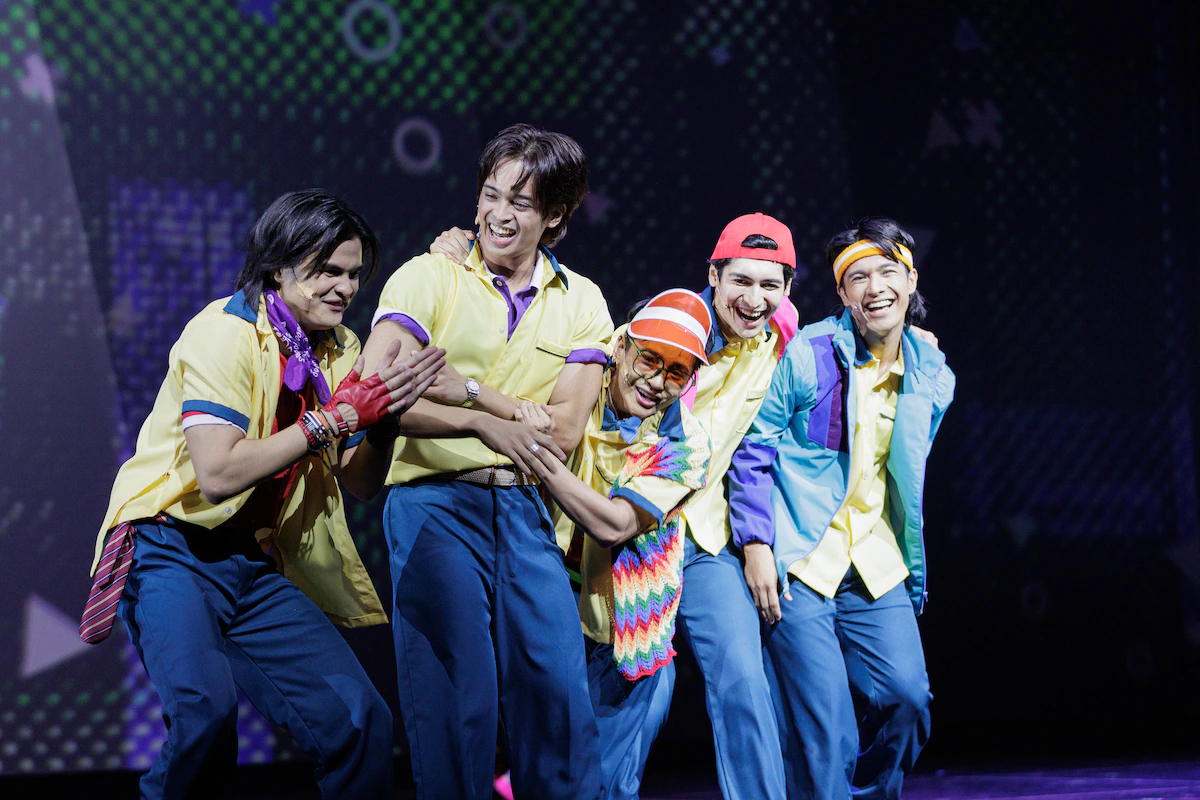
And yet, re-watching “Bagets” today as a stage musical — more than four decades after the original movie’s February 1984 release — it’s difficult not to feel a twinge of wistfulness for a time that now seems gentler, even accidental in its innocence. I was the same age as the film’s characters when “Bagets” first came out, which may explain why what now reads as naïve feels lived-in to me. Yes, there are moments that make you cringe: the zippered pants, the layered polo shirts, the hair stiff with gel. These don’t exactly scream timeless cool. But nostalgia has a way of sanding down rough edges, and whether we admit it or not, there is something we miss about that era. Totally.
“Bagets” — both the film and the musical — are not, by any stretch, artistic masterpieces. The movie’s director Maryo J. De los Reyes had already shown greater emotional depth in “High School Circa ’65,” while Ishmael Bernal would later offer a more sobering portrait of youth anxiety in “The Graduates.” (As far as jukebox musicals are concerned, PETA set the bar high with “Rak of Aegis.”) In contrast, “Bagets” feels lighter, almost aimless.
Originally conceived as a star-building vehicle for Viva Films’ stable of teen heartthrobs — notably a then 15-year-old Aga Muhlach — the movie nonetheless became something more enduring: a generational touchstone. Perhaps unintentionally, it captured not just what we looked like, but what we worried about — and what we didn’t.
The boys of “Bagets” weren’t ultra-privileged kids with access to helicopters and beach houses, as in many Sharon Cuneta vehicles. But they were also not experiencing extreme hardship. Adie, Gilbert, Topee, and Arnel were middle-class teenagers who got kicked out of their exclusive school and transferred elsewhere for their final year — but not before meeting four-time repeater Tonton, who instinctively assumed leadership.

Not much happens to them, really. There are crushes and barkada mischief, but also a tragic drag-racing accident that forces a moment of reckoning before graduation. That’s it. And maybe that’s the point.
“Bagets” presents a version of middle-class adolescence that will feel instantly familiar to anyone who came of age in the ’80s. Our first encounters with sex were awkward and furtive — often involving places like massage parlors along Quezon Avenue, with a sense of secrecy and risk. Crude as that sounds now, it functioned less as a moral collapse than as a rite of passage in a pre-digital world.
This was before intimacy became algorithmic, before desire was mediated by screens, apps, and performative openness. Compared to today — where exposure is constant and boundaries blur early — the idea of fumbling through early crushes or exploring curiosity in slightly risky ways feels almost quaint, even old-fashioned.
Back then, summer breaks meant uncomplicated trips to Baguio or a Batangas beach. When we cut class or celebrated minor victories, there was Shakey’s — where pitchers of draft beer might be enjoyed under less scrutiny than today. More often, we just hung out at a friend’s house, listened to music, and maybe passed around a joint. Our rebellions were modest, almost polite.
The music of “Bagets” remains a perfect time capsule. In 1984, Michael Jackson dominated pop culture, long before today’s controversies reshaped his legacy. New Wave was just beginning to bleed into the Top 40.
The movie also captured our surprisingly lasting flirtation with pop-jazz. There’s something telling about Tonton lecturing about the future while listening to Clarke/Duke Project — it was the sound of a generation trying to feel sophisticated before the world got complicated, and which carried us through our early adulting years.

And yes — we dressed like that, loud colors and all. The preppier kids flaunted Lacoste and Polo. The girls wore ruffled dresses, oversized hoop earrings, and hair sprayed into architectural defiance. Coolness was either about fashion or fraternity affiliation. Violence, when it existed, felt contained. Death felt distant.
What hits hardest today, though, is not the fashion or the music — it’s the family structure. The world of “Bagets” was one where broken homes existed, but were not the norm. None of the boys have OFW parents. Their home lives assumed stability, a context different from many contemporary Filipino teens whose families are likely grappling with migration or other challenges.
Today, those characters would be in their late 50s, the Gen X parents scrolling through Facebook with steady jobs and intact families, hosting reunions fueled by nostalgia and old playlists. We are baffled by today’s generation, secretly amused, occasionally judgmental. We still light up a joint once in a while and talk endlessly about the old days.
We may still go wild when we hear the opening bass line of “Build Me Up Buttercup” or Kool & the Gang’s “Celebration,” but it’s jazz — “Sweet Baby” or “Stay Awake” — that sends us into quiet reflection.
In hindsight, growing up in the early ’80s gave us something rare: a final, unselfconscious taste of innocence. We were too young to have felt the full weight of Martial Law; our battles were fought against Space Invaders compared to the real struggles our elders faced. Our greatest trauma was the banning of “Voltes V.”
But while we were learning the steps to “Beat It,” the foundations of the country were shifting. Ninoy Aquino’s assassination had already happened, although the EDSA Revolution was still two years away. We were living in the final, golden hours of a specific kind of Filipino adolescence — a bubble of gelled hair and neon-colored clothes, right before the sea-change began.
Looking back from 2026, it’s clear: we really did just get lucky.
This article was originally published on ABS-CBN.com.




Leave a Reply