Exiting the theater, my immediate thought was clear: this is Repertory Philippines entering a new era.
The musical has a special place in the company’s history. It was a favorite of Rep founder Zenaida Amador, and the company has staged it twice before — first with Miguel Faustmann as Don Quixote, then in a tribute production following Amador’s death, with Michael Williams and Audie Gemora alternating in the title role. Choosing it as the banner production of Rep’s latest season feels both symbolic and fitting.
Despite its stature as a musical theater classic, “Man of La Mancha” has often struggled to connect with contemporary audiences. Its score, apart from the enduring anthem “The Impossible Dream,” is not especially memorable, while Dale Wasserman’s adaptation of Miguel de Cervantes’ “Don Quixote” can feel episodic and dated. The 1972 film adaptation certainly did little to improve my opinion of the material.
That is precisely why director Nelsito Gomez proves to be this revival’s greatest asset.
Gomez, who began his theater career with Rep before emerging as one of the country’s most inventive directors, has built a reputation for reimagining classics with clarity and purpose. Last year, he transformed Goethe’s “Faust” into a dialogue-free rock musical using the music of Wolfgang. Here, he brings the same instinct for reinvention to “Man of La Mancha.”
Wasserman frames the story by placing Cervantes in prison while awaiting trial by the Spanish Inquisition. To defend himself before his fellow prisoners, Cervantes stages the story of Don Quixote, with the inmates assuming the various roles.

Nonie Buencamino in ‘Man of La Mancha.’ Krizhal Daryl Ordas of Indio Creatives
Gomez seizes upon that framing device and turns it into the production’s defining idea.
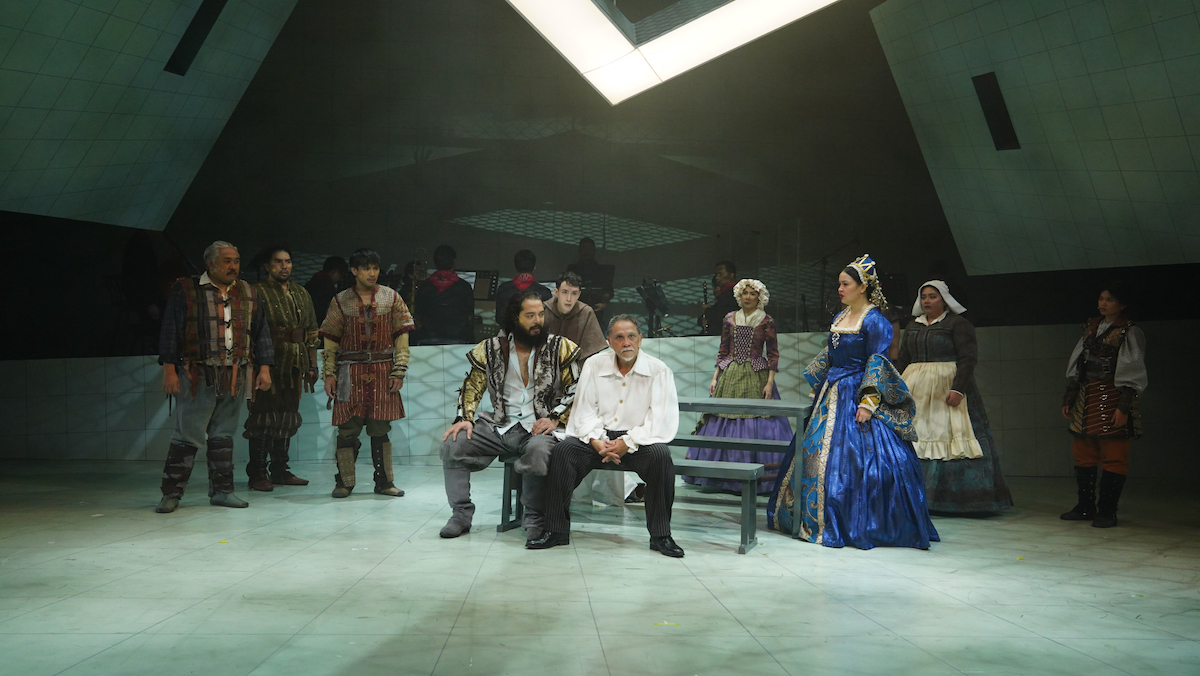
Instead of a medieval dungeon, Cervantes finds himself in a stark, fluorescent-lit immigrant detention facility. Surrounded by a chain-link fence and sterile white walls, the setting evokes the holding pens associated with immigration crackdowns in the United States and, more broadly, the refugee and migration crises that continue to shape global politics.
The opening moments immediately signal that this is not a museum-piece revival. The production reframes the musical as a meditation on human dignity. It is a bold choice, but one that pays off handsomely.

When the prisoners begin to enact the story of Don Quixote, the confining walls gradually open up and expand. The visual effect is striking: imagination becomes liberation. Theater itself becomes an act of resistance against confinement, whether physical, political or psychological.
In one elegant conceptual stroke, Gomez makes a 60-year-old musical feel urgently contemporary.
His approach extends beyond the setting. Running a lean two hours without intermission, the production benefits from Gomez’s trademark economy. Rather than attempting to overwhelm audiences with spectacle, he strips the material down to its essentials.
That restraint proves to be one of the revival’s greatest strengths.
Musical director Farley Asuncion likewise embraces simplicity. While the production employs a variety of instruments, it avoids the lushness of a full Broadway-style orchestra. Instead, Asuncion highlights the spare beauty of Spanish guitar textures, allowing the score’s emotional core to emerge with surprising clarity.
The performances complete the production’s success.

As Aldonza, Katrine Sunga delivers a performance of remarkable emotional force. Best known to many audiences from “Ang Holing El Bimbo,” Sunga brings grit and vulnerability to a character often defined by her suffering. Her quiet intensity builds steadily throughout the show before culminating in a heartbreaking reprise of “Dulcinea” near the finale. It becomes one of the production’s most moving moments.
The production is also buoyed by a remarkably nimble ensemble. Like an efficient Shakespearean troupe, the actors slip seamlessly between roles, conjuring entire worlds through performance rather than elaborate theatrical machinery. Their work reinforces one of Gomez’s central ideas: that the power of theater lies not in spectacle but in the shared act of imagination between performers and audience.
Then there is Nonie Buencamino, who seems uniquely suited to play Don Quixote at this stage of his career.
Buencamino possesses the gravitas, intelligence and emotional depth required to navigate the role’s multiple layers, moving effortlessly between Cervantes, Alonso Quijano and the self-fashioned knight Don Quixote. While many portrayals lean heavily into the character’s absurdity, Buencamino never loses sight of the man’s essential dignity.
His Don Quixote is not merely a delusional dreamer. He is a fundamentally decent man who refuses to surrender his belief that the world can be better than it is.

That conviction gives fresh power to “The Impossible Dream,” a song that has been performed so often it risks becoming little more than a familiar standard. Buencamino restores its sense of purpose. For a few minutes, he makes the audience believe again in idealism — not as naïveté, but as a necessary act of courage.
By the time the anthem returns in the finale, sung by detainees who have inherited Don Quixote’s vision, it no longer sounds like a sentimental Broadway showstopper but becomes an act of defiance.
In Gomez’s hands, “Man of La Mancha” is transformed from a beloved classic into a timely political statement about hope in an increasingly fractured world. More importantly, it demonstrates a willingness by Repertory Philippines to engage with contemporary realities rather than simply preserve tradition.
“When life itself seems lunatic,” Don Quixote asks, “who knows where madness lies?” In a world increasingly defined by cynicism, this revival suggests that perhaps the real folly is giving up on the impossible dream altogether.

“Man of La Mancha” runs until June 28 at the Rep Eastwood Theater.
This review was originally published on ABS-CBN.com.


Leave a Reply