I first saw “El Fuego del Alma” when it was still a staged reading in May. Even then, it was clear that there was something here worth pursuing. The reading was essentially a test of the waters — a chance to see whether audiences would connect with Eljay Castro Deldoc’s Filipino adaptation and translation of Tennessee Williams’ “Summer and Smoke.”
The answer, at least from where I was sitting, was an emphatic yes.
I was told that a full production would run close to three hours, but the version presented during the reading clocked in at just over an hour. Even in that compressed form, it managed to hit the major emotional and narrative beats of Williams’ play. The audience remained locked in, including those unfamiliar with the source material. The storytelling was clear, the performances sharp, and, most importantly, the production captured that signature Williams tension — the quiet, simmering push and pull between desire and restraint that threatens to erupt at any moment.
Now, months later, “El Fuego del Alma” is a fully staged production but still keeping it edited. This slightly expanded production runs just a little longer than the staged reading, with additional transitional scenes and characters, but it remains remarkably focused.
Many of my theater colleagues have been calling “El Fuego del Alma” one of the best plays of the year — and much of that has to do with director Mark Mirando’s vision and use of space.

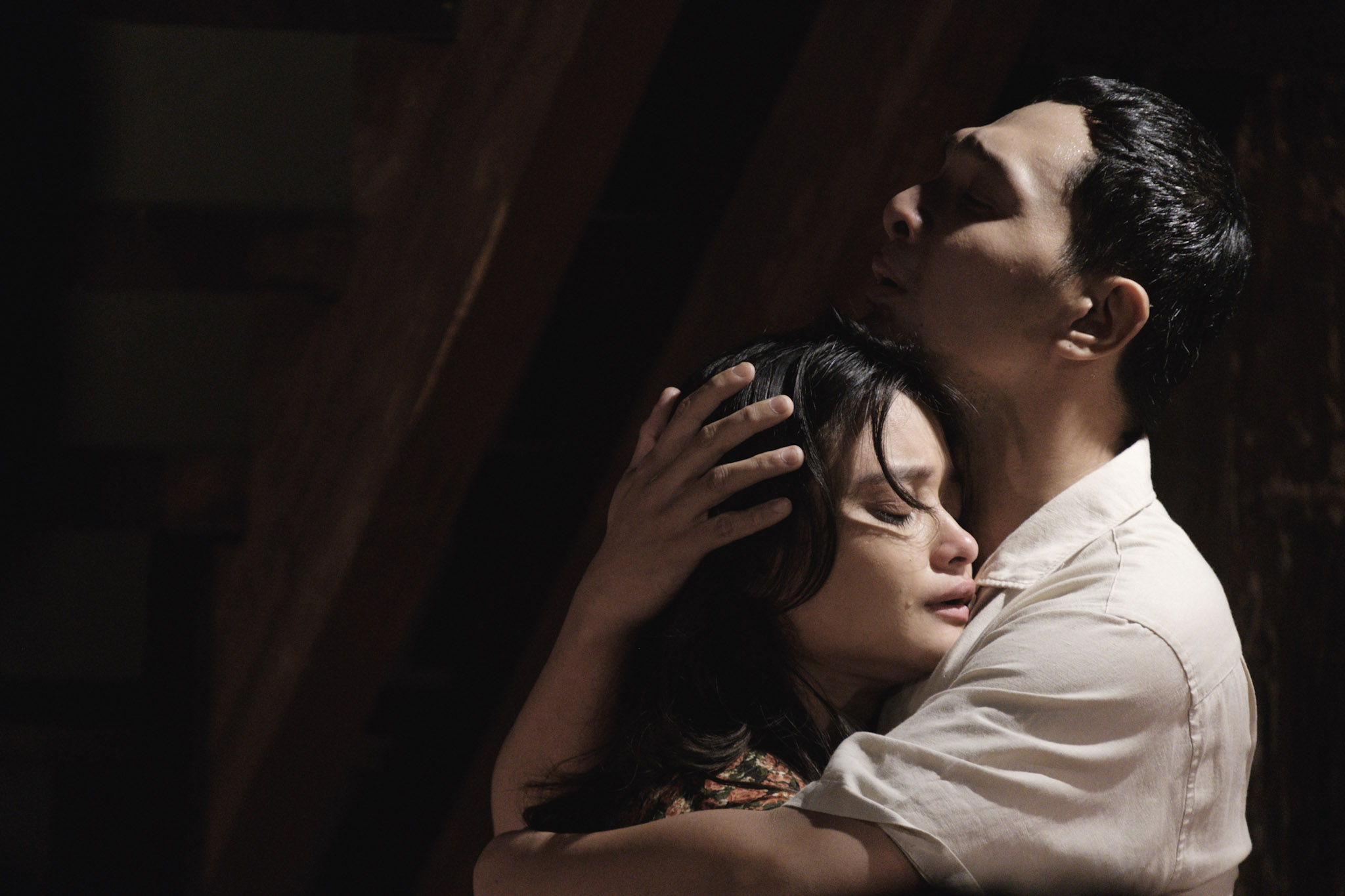
Sandino Martin and Nour Hooshmand in ‘El Fuego del Alma.’ Trish Shishikura
Sine Pop is an unexpected little gem tucked into a rougher corner of Cubao, right beside a motel, of all places. The production doesn’t need a traditional theater set because it has something far more interesting: a repurposed two-story house.
Furniture, staircases, doors and windows become part of the staging. Nothing feels merely decorative. The house itself becomes a character, shaping the movement and relationships of the people inside it.
Then there is the Japanese bamboo rock garden outside, framed by a glass panel that creates an almost cinematic, letterbox-like view. At certain points, the action spills outdoors. You see and hear actors outside while scenes continue inside. Sound travels across the spaces, creating an almost surround-sound theatrical experience.
During the staged reading, even with actors still holding scripts, Mirando was already using the architecture of Sine Pop to tell the story. But in the full production, that vision has been expanded and sharpened. The staging is more deliberate and purposeful.
And then there is the weather. The first time I saw the play, it was a sunny Saturday afternoon. During the final scene, with the sun beginning to set, it was a beautiful, almost too perfect ending.

Sandino Martin and Nour Hooshmand in ‘El Fuego del Alma.’ Trish Shishikura
This time, I saw it on a rainy Sunday night and it was an entirely different “El Fuego del Alma.” Instead of a steamy summer night, we had the height of the rainy season. Actors appeared outside beneath translucent umbrellas, as rain glistened under the lights. The house suddenly felt more enclosed, more intimate, more kulob — which turned out to be a more ideal atmosphere for this story.
The rain makes you feel as if everyone is trapped inside the house — physically and emotionally. It becomes a mirror for the characters, whose desires are similarly trapped beneath obligations and fears.
The result is a production that feels more sensual and intimate than the one I saw in May. The material doesn’t simply survive the change in weather; it seems to absorb it.
Deldoc and Mirando have created a distinctly Filipino world around “Summer and Smoke,” placing the story in a provincial setting and infusing it with Filipino melodrama, religion, hypocrisy and the suffocating expectations of a small community.
The addition of two townspeople, who function almost like a Greek chorus of provincial gossip, is particularly effective. Their presence establishes the social machinery surrounding the characters — the whispers, judgments and scandals that can become just as oppressive as family expectations. This is a world where reputation matters, where everyone knows everyone else’s business, and where small-town morality can become its own form of imprisonment.
And it is all housed within a very specific, unmistakably Filipino post-war home.

Sandino Martin in ‘El Fuego del Alma.’ Trish Shishikura
The cast has also deepened considerably since the staged reading. I saw Sandino Martin again as Juanito, and he is even better this time around. His characterization feels fuller and more internalized. There is less sense of an actor playing the role and more of a man wrestling with himself.
Nour Hooshmand’s Alma gives the character a different but equally compelling dimension. Her Alma feels particularly trapped by responsibility and family loyalty, bound by expectations that prevent her from fully becoming the woman she wants to be.
That makes for an interesting contrast with Opaline Santos, whom I saw as Alma during the staged reading. Santos’ Alma was more conservative, religious and almost spinster-like. Hooshmand’s interpretation feels more emotionally imprisoned, with the character’s restraint coming less from personal conviction than from the weight of everything expected of her.
Santos now plays Rosa, and she brings a sensuality to the role that is almost scorching — even on a cold, wet night. I remember singling Santos out after the staged reading because there was a quiet strength in her performance that lingered. She remains an actor who deserves far more recognition.
But ultimately, “El Fuego del Alma “ belongs to Mirando. What could have been simply a Filipino translation of a Tennessee Williams classic has become something closer to a reimagining. Deldoc’s adaptation provides the Filipino language and context, but Mirando finds a theatrical vocabulary to match it — one built around space, weather, sound and physical proximity.
The live musical scoring and sound design deserve special mention. Music is present throughout, while carefully constructed sound effects heighten the sense of the weather outside. Rain isn’t merely something the audience sees through the glass. It becomes part of the production’s soundscape and mood.
That is what makes this production so memorable. A thoughtful study in spatial storytelling, “El Fuego del Alma” succeeds by letting the venue, the live score, and even the weather actively shape the drama unfolding on stage.
There is only one weekend left, and the remaining shows are sold out. If a ticket happens to become available, take it. But I have a feeling this isn’t the last we’ll see of “El Fuego del Alma.” A production this assured, this distinctive, deserves another life.

“El Fuego del Alma” runs until August 23, 2026 at Sine Pop in Cubao, Quezon City


Leave a Reply