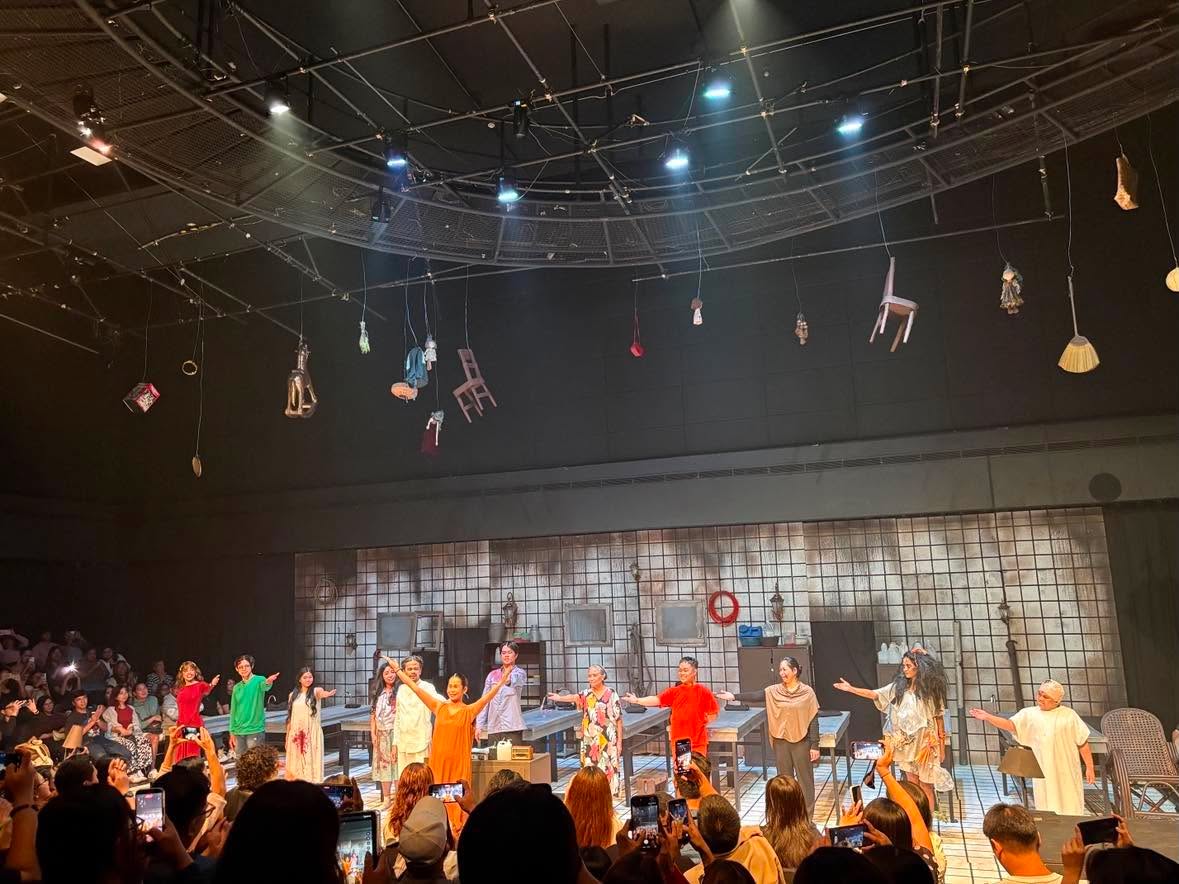
At this point in my life and career as an avid theatergoer and reviewer, I’ve mellowed.
If you liked a play that I didn’t, I’m still happy for you. You had a good experience, and hopefully that will make you want to see another show and, in some small way, help grow the theater community.
If you didn’t like a play that I loved, I’ll probably want to talk to you about it. I’ll ask what didn’t work for you, try to understand where you’re coming from, and perhaps point out things you may have missed or interpreted differently. Maybe, in the process, I can convince you to see the merits of the play.
That’s how I approach theater now — and that’s why I wasn’t particularly eager to write about Studio A Productions’ musical “Tulog Na.”
My colleagues have already published their reviews, and I agree with them completely. I figured there wasn’t much more I needed to say.
Then I saw another digital ad for the production. It featured a purported audience reaction defending the show against its negative reviews: “Pareho ba tayo ng napanood?”
It’s a provocative question, so let me throw it right back: Pareho nga ba tayo ng napanood?
When I go into a theater, I’m not looking for flaws. I’m not sitting there waiting to pounce on mistakes. I can watch an extremely fringe production — minimal budget, practically no set, very few technical resources — and still walk out enthralled. Conversely, I can watch a major musical with all the bells and whistles — elaborate scenery, a big cast, expensive costumes — and still walk out completely unmoved.
Nor do I expect every play to aspire to greatness. Like movies and books, theater can have different ambitions. Some productions want to be profound. Others simply want to entertain. Some reach for something ambitious and fail — and that’s OK too.
There’s absolutely nothing wrong with making commercial theater, either. Theater costs money. People need to be paid. Producers need to recover their investment. Audiences are willing to spend money on entertainment, and there’s a legitimate business in that.
“Tulog Na” understands this well. With tickets reaching P4,000 (I paid P3,500 for mine) and an aggressive digital marketing campaign behind it, the production clearly knows how to sell itself, and Studio A deserves credit for that. They understand their audience, know how to generate buzz, and have been remarkably effective at getting people into the theater.
My problem isn’t that “Tulog Na” is commercial. It’s that I never felt the production was equally invested in the people at the center of its story.
The premise is actually interesting: imagine “Toy Story” set in a morgue, where the dead bodies come to life and start talking among themselves once the living characters leave. From there, the show adopts something of a “Vagina Monologues” structure, with each character delivering a monologue about their life and, ultimately, how they died.
That could have been fascinating. A morgue as a cross-section of society — a child who succumbs to illness, a homeless woman, an overseas Filipino worker, a prisoner, and others.
But I kept asking myself: where is the empathy? The stories often feel like a mere catalogue of ways people can die. Someone is killed with an ice pick to the neck, and the violence is presented almost as a plot detail. A young woman recounts being gang-raped, and the gravity of that experience gets roughly the same dramatic treatment as everyone else’s confessions. Then there’s the character who dies by suicide — only to be blamed for having made that choice.
It’s 2026. Why are we still doing this?
There’s something deeply uncomfortable about the emotional distance with which these characters are treated. The morgue is cold, literally and figuratively, and the production doesn’t seem to make an effort to bridge that distance.
The songs don’t help. They arrive as extremely short musical interludes, sometimes barely a minute long, cycling through variations of regret, remorse, and apology. Rather than deepening the characters or advancing the story, they often feel like just another version of the same emotional beat.
The result is a production that keeps telling us these characters have suffered without giving us enough reason to actually feel their suffering. That, to me, is the fundamental problem. It lacks empathy. It lacks subtlety. And, most importantly, it lacks the sense that these characters were written with real care.
And that’s just the book.
Of course, plenty of movies and TV shows operate this way. There’s an entire ecosystem of melodramatic storytelling built also on exaggerated situations, hysterical performances, and emotional manipulation. (Vertical dramas, anyone?) But we tend to dismiss those as rubbish, or embrace them, at best, as guilty pleasures.
If “Tulog Na” works for you on that level, I won’t fault you for it. If you laughed, cried, enjoyed the performances, or just had a great night out, then good for you.
But I do think we need to distinguish between liking something and proclaiming that it’s good theater. Those aren’t the same thing — which is why I have trouble with the “Pareho ba tayo ng napanood?” defense.
So here’s my challenge: if you’re willing to spend as much as P4,000 on a ticket, please go explore what else Philippine theater has to offer. There are companies producing remarkable work at considerably lower ticket prices. There are intimate plays with tiny budgets that deliver far more genuine, sincere, and deeply human experiences.
Because Philippine theater is having an exciting moment. There’s so much happening across so many companies and so much work that deserves an audience.
Which brings me back to Studio A.
I have to hand it to them: they’re very, very good at marketing. Brutal, yes — but also brilliant. Perhaps Studio A should consider offering marketing workshops to other theater companies. There’s something to learn from how effectively they’ve built awareness around “Tulog Na,” generated conversation, and converted that attention into ticket sales.
And there’s progress here, too. The company is now willing to spend on a performer like Pokwang. It’s willing to license a song from Sugarfree, even if that song is used only once, in the finale, and ultimately feels unnecessary. Those are still steps forward.
If you loved “Tulog Na,” I’m genuinely glad you found something in it.
But if you didn’t like the play, know that many of us feel the same way. I hope this experience doesn’t discourage you from seeing other shows — there’s plenty out there that may suit you far better.


Leave a Reply