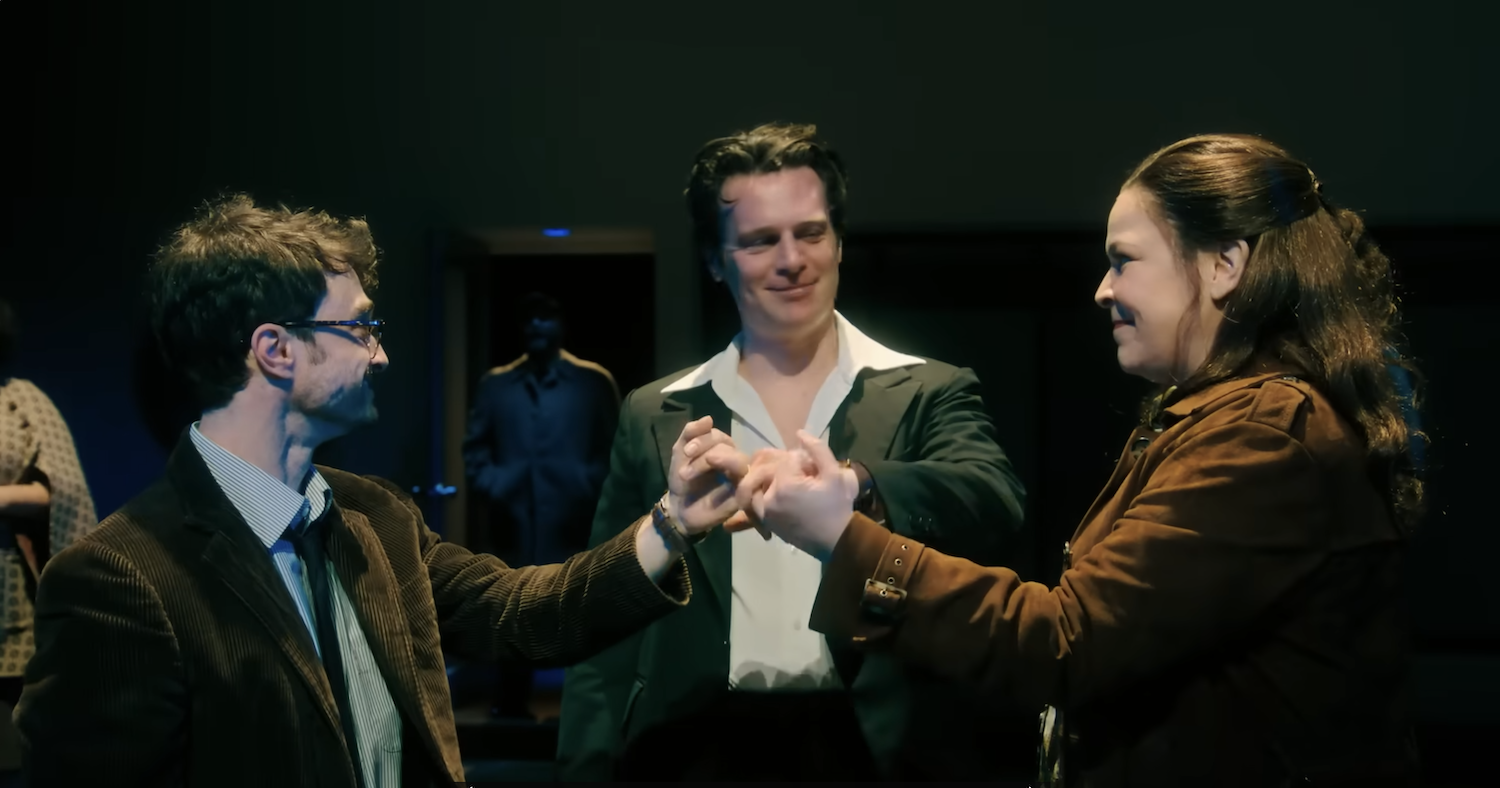
There’s something quietly powerful about finally experiencing a musical you’ve only known through its cast recording. This year alone, I crossed two off that list — first “A Chorus Line,” and now “Merrily We Roll Along” — and both surprised me in the same way: they hit harder than I ever expected.
I’ve been listening to “Merrily” for years. I knew the conceit — a story told backwards, tracing the unraveling of a decades-long friendship among three artists — but that was about it. What I didn’t anticipate was just how emotional the full experience would be once the songs were placed back into their dramatic context.
With a book by George Furth, there are echoes here of “Company” — that same ‘70s fascination with adult relationships, compromise, and the quiet costs of the choices we make. But “Merrily” cuts even deeper.
It’s almost ironic that this is Stephen Sondheim’s first major flop, closing after just 16 performances in 1981. Watching it now, you begin to understand why it struggled then. Beyond the reverse chronology — which was already a challenge — the original production cast very young actors who had to age decades over the course of the show. It was a bold idea, but perhaps one that audiences at the time couldn’t quite meet halfway.

The recent Broadway revival, captured in the pro-shot, solves that problem elegantly. Casting performers who already carry the weight of experience allows the story to land with clarity and emotional truth from the very first scene. Jonathan Groff, Lindsay Mendez, and especially Daniel Radcliffe form a trio with extraordinary chemistry. On film, the close-ups become an unexpected gift — you see every flicker of regret, resentment, and longing in ways even the best theater seat might miss.

Groff’s Frank Shepard is magnetic, but it’s Radcliffe who nearly walks away with the show. His “Franklin Shepard, Inc.” is a tour de force — funny, frantic, and devastating all at once.
What struck me most, though, is how deeply the musical resonates as a story about selling out. Frank begins as a gifted composer, full of promise, only to trade his art for commercial success in Hollywood — losing, in the process, not just his artistic voice, but his closest relationships. It’s a story that feels distinctly Gen X in its anxieties. For many of us, “selling out” wasn’t just a casual compromise; it was almost a moral failure.
That idea doesn’t seem to carry the same weight today. For younger generations, the lines between art, commerce, and survival are more fluid. But “Merrily We Roll Along” comes from a time when those lines felt sharper — and the cost of crossing them, more profound.
Hearing the songs in context only deepens that impact. “Not a Day Goes By,” which I had loved in isolation, becomes quietly devastating within the story. “Our Time,” which I always imagined as a graduation anthem, emerges instead as a hopeful beginning — making its eventual unraveling all the more heartbreaking. And “Good Thing Going,” still one of my favorite Sondheim songs, lands with a bittersweet clarity that lingers long after.
By the time the show circles back to youth — to hope, to possibility — you’re left not with nostalgia, but with something closer to grief. You know exactly where these characters will end up, and what they will lose along the way.
Watching this, I couldn’t help but think how well it might translate locally. The material feels ripe for reinterpretation, and the roles themselves are irresistible for actors. I could already see Alfredo Reyes as Frank or maybe Jef Flores, Reb Atadero as Charley, and Mikkie Bradshaw-Volante as Mary.
If you can find this pro-shot, watch it. It’s one of those rare experiences where admiration turns into something more personal. I found myself applauding at the end… and then, unexpectedly, sitting with it long after, a little undone.

Leave a Reply